
GST Verified Manufacturer Bhayander West, Thane, Maharashtra, India +91-8047836571 · 88% Response Rate
Send Business Enquiry
0%

Choosing Optical Acetate Sheet Frames requires more than comparing colors, logos, or glossy finishes. The World Health Organization’s World Report on Vision estimates that at least 2.2 billion people live with near or distance vision impairment. Corrective eyewear therefore carries practical importance, not only fashion value. Frame comfort, optical alignment, durability, and professional fitting should guide every purchase.

Market evidence also shows why material knowledge matters. Grand View Research estimates that the global eyewear market reached approximately USD 154 billion in 2023, with continued growth expected through 2030. This expansion has increased access to acetate designs, but quality can vary sharply. High-quality cellulose acetate sheets usually offer layered color, controlled flexibility, and a smoother hand-polished surface. Cheap imitations may look similar under showroom lighting. They may feel different after six hours of wear.

Look closely. Inspect the edge, bridge, hinges, and temple thickness. A well-made frame should sit evenly without pressing the nose or slipping behind the ears. Ask whether the frame uses genuine cellulose acetate, what hinge system it contains, and whether it complies with relevant optical-frame standards, such as ISO 12870. Sustainability claims also need evidence. “Eco-friendly” alone proves very little. Supplier documentation, material traceability, and responsible manufacturing practices matter more.

The best choice depends on prescription strength, face shape, wearing habits, and maintenance expectations. Thicker sheet construction may support stronger visual character, yet it can add weight. Transparent acetate reveals structure beautifully, but it may show scratches quickly. There is no perfect frame. Careful comparison remains essential.
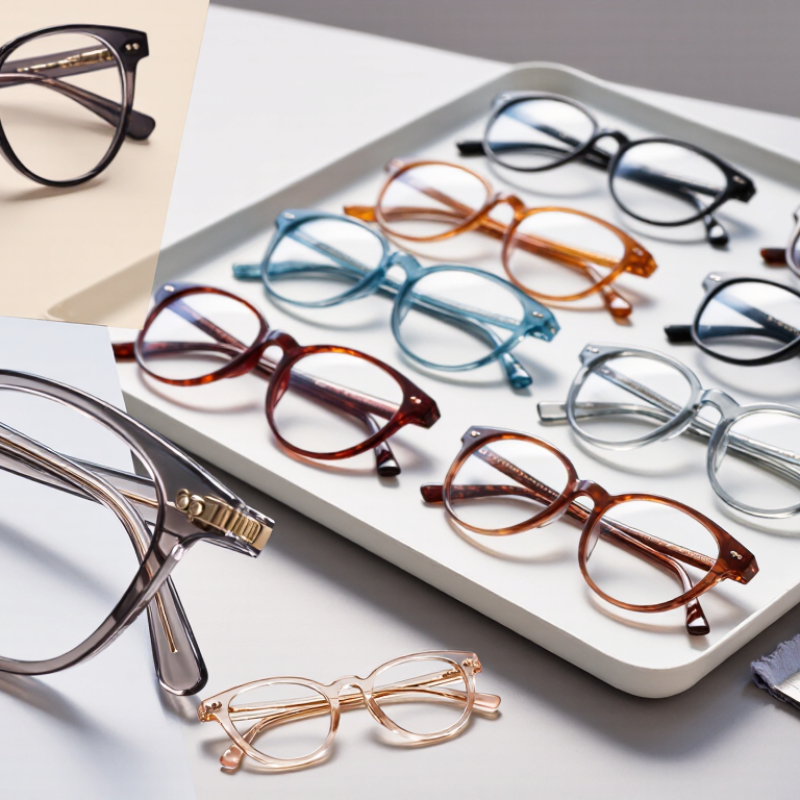
How to Choose Optical Acetate Sheet Frames?

Verify Material: Cellulose Acetate Typically Measures ~1.3 g/cm³

When choosing optical acetate sheet frames, verify the material before judging color or finish. Cellulose acetate typically measures about 1.3 g/cm³. This density is a useful quality check, not a complete identification test. Measure twice.

Ask for a technical data sheet showing density, composition, and thickness tolerance. A simple workshop test can also help. Weigh a clean sample with a precise scale, then calculate its volume from length, width, and thickness. Divide mass by volume. The result should sit near 1.3 g/cm³, although plasticizers, pigments, moisture, and surface coatings may change it slightly. Small details matter.

I have found that visual inspection alone can mislead. A thick, polished sheet may feel substantial but still contain a different material blend. Density results can also become unreliable when the sample has curved edges or uneven thickness. Check several points on the sheet, especially near the edge and center. Compare the measurements with the supplier’s documented specification, then inspect flexibility, layer bonding, and machining behavior. Genuine cellulose acetate usually cuts cleanly and develops a smooth, warm surface after polishing. Still, these signs are supportive evidence, not proof. A careful buyer should record the test conditions, because temperature and moisture can affect measurements. The process is not flawless, but it is more dependable than choosing by appearance alone.

Read Frame Codes: Match A, DBL, and Temple Length in Millimeters

How to Choose Optical Acetate Sheet Frames?

Read Frame Codes: Match A, DBL, and Temple Length in Millimeters

When choosing optical acetate sheet frames, read the three-part code printed inside the temple. A usually means lens width, measured horizontally in millimeters. DBL means distance between lenses, or bridge width. Temple length describes the arm from hinge to ear tip. A code such as 52-18-140 indicates a 52 mm lens, an 18 mm bridge, and a 140 mm temple.

Numbers make comparison easier, but they do not replace a real fitting. A larger A measurement creates more lens space and may suit wider faces. A smaller DBL can position the frame closer to the nose. Check whether the bridge rests securely without pinching. The temple should reach the ear without pressing behind it. Small differences matter.

Acetate can feel warm and substantial, especially around thick rims and polished edges. I once selected a frame by lens width alone, then noticed the bridge sat too low. That choice looked fine in a photograph, but it felt unstable during reading. My mistake was ignoring facial height and nose shape. Measure a frame that already fits, then compare its A, DBL, and temple values. Allow for hinge construction and temple curvature, because printed measurements may not show the full wearing experience. When the code is unclear, ask an optical professional to confirm the measurements before ordering.

Set Optical Fit: Align Frame PD With the Wearer’s Monocular PD

How to Choose Optical Acetate Sheet Frames?

Set Optical Fit: Align Frame PD With the Wearer’s Monocular PD

Optical acetate frames look substantial, but their appearance can hide fitting errors. Measure the wearer’s monocular PD, not only the total PD. Frame PD combines lens width and bridge size. Each lens center should match the corresponding eye. Even a small mismatch can increase unwanted prism and cause eye strain. ISO 21987:2017 highlights accurate lens positioning as part of quality spectacle assembly. The World Health Organization also reports that at least 2.2 billion people live with near or distance vision impairment. Precise fitting therefore matters beyond appearance.

Check the frame while it rests naturally on the nose. A wide acetate bridge may shift the frame downward. Thick rims can also obscure the pupil center. During practical fitting, I recheck monocular PD after adjusting the temples. I still find that a clean measurement can fail when the wearer tilts their head. That detail is easy to miss. If frame PD differs from the wearer’s total PD, calculate the horizontal decentration for each eye. Keep high prescriptions especially close to the measured optical centers.

Tips: Record right and left PD separately. Mark pupil centers on a fitting demo lens. Check pantoscopic tilt, vertex distance, and bridge contact. Ask the wearer to look straight ahead. Do not trust the frame size alone. The Vision Council’s consumer research continues to show strong demand for corrective eyewear, yet comfort remains personal. A technically correct fit may still need one more adjustment.

Check Compliance: Apply ISO 12870:2016 Frame-Test Requirements

How to Choose Optical Acetate Sheet Frames?

Acetate frames should be judged beyond color, polish, and sheet thickness. Check compliance with ISO 12870:2016, the recognized standard for ophthalmic spectacle frames. It defines frame construction requirements and test methods for mechanical strength, dimensional stability, lens retention, and resistance to sweat. These tests reveal weaknesses that a showroom inspection may miss. A frame can look flawless yet loosen after repeated opening and closing.

Ask the supplier for a current test report linked to the exact frame design. Confirm that the report identifies the tested material, dimensions, hinges, and production batch. ISO testing is meaningful only when samples represent actual manufacturing. The World Health Organization reported that at least 2.2 billion people had vision impairment worldwide in its World report on vision. Reliable frames therefore support a much larger need for safe, durable vision correction.

Tips: Inspect the bridge and hinge areas closely. Look for clean edges, even surface finishing, and stable hinge movement. Ask whether sweat-resistance testing was completed. Also check lens retention after mechanical testing. I would not rely on “premium acetate” as proof of quality. That phrase sounds useful, but it proves little without documented results. Even experienced buyers can overlook small dimensional changes.

Inspect Craftsmanship: Review 3–5 mm Front Thickness and Edge Polish

When choosing optical acetate sheet frames, inspect the front before admiring the color. A 3–5 mm front often provides useful structure, especially around the bridge and hinge zones. However, thickness alone does not prove quality. Uneven milling can leave one rim heavier, while excessive material may make the frame feel clumsy.

Hold the frame under a bright, angled light. The surface should show consistent transparency, with no cloudy patches, deep sanding lines, or trapped dust. Run a fingertip along the edge. A properly polished edge feels smooth and rounded, not sharp or waxy. In my workshop experience, the best polish reflects light as one continuous line. Small ripples usually reveal rushed buffing. I may miss them at first.

Grand View Research valued the global eyewear market at about USD 157.9 billion in 2023, showing strong demand for better-finished products. Market growth does not guarantee better craftsmanship. ISO 12870 testing also emphasizes frame durability and construction, but it cannot replace a close visual inspection. Ask how the sheet was laminated, cut, and polished. Look closely at the endpieces, where uneven thickness is easier to hide. A 4 mm front with clean edges may outperform a thicker frame with weak finishing. The detail matters.

FAQS

What do the numbers inside an optical frame mean?

A code like 52-18-140 usually lists lens width, bridge width, and temple length in millimeters.

What does the A measurement describe?

A usually means the horizontal lens width. Larger numbers may suit wider faces. Measure a frame that already fits.

What does DBL mean?

DBL means the distance between lenses, or bridge width. A smaller DBL may place the frame closer to your nose.

Can measurements guarantee a comfortable fit?

No. Numbers help comparison, but facial height, nose shape, hinge design, and temple curvature also affect comfort.

How should the bridge fit?

The bridge should rest securely without pinching. It should not slide during reading or leave obvious pressure marks.

How long should the temple arms be?

The temple should reach the ear comfortably. It should not press behind the ear or stop too early.

What front thickness is common for acetate frames?

A 3–5 mm front can provide useful structure around the bridge and hinge areas. Thicker is not always better.

How can I inspect the frame surface?

Hold it under bright, angled light. Look for cloudy patches, sanding lines, trapped dust, or uneven transparency.

What does a well-polished edge feel like?

It should feel smooth and rounded. A continuous reflected light line often suggests careful polishing. I may miss small ripples at first.

What should I check before ordering online?

Compare the frame code with one that fits you. Confirm unclear measurements with an optical professional, especially around the hinges.

Conclusion

Choosing Optical Acetate Sheet Frames requires more than selecting an attractive color or shape. Start by verifying the material: genuine cellulose acetate commonly has a density of approximately 1.3 g/cm³, which can help distinguish it from unsuitable substitutes. Next, read the frame measurements carefully. The A size, DBL (distance between lenses), and temple length should all be listed in millimeters so you can compare them accurately with the wearer’s needs. For a comfortable optical fit, the frame’s total PD should align closely with the wearer’s combined monocular PD, helping position each lens correctly in front of the eyes.

Quality and compliance are equally important. Check that the frame is designed and tested according to the relevant requirements of ISO 12870:2016, including durability and performance expectations. Finally, inspect the workmanship in detail. A front thickness of around 3–5 mm may provide a balanced structure, while smooth, consistently polished edges improve comfort and appearance. Combining material verification, precise measurements, optical alignment, testing awareness, and careful finishing inspection makes frame selection more reliable.

Evelyn

Evelyn

Evelyn is a dedicated marketing professional who combines strategic insight, clear communication, and a deep understanding of customer needs. With extensive knowledge of the company’s products and services, she plays an important role in presenting their value to audiences across different......